Monreale Cathedral
the internal areas

The columns of the nave: the meticulous study of the overall order

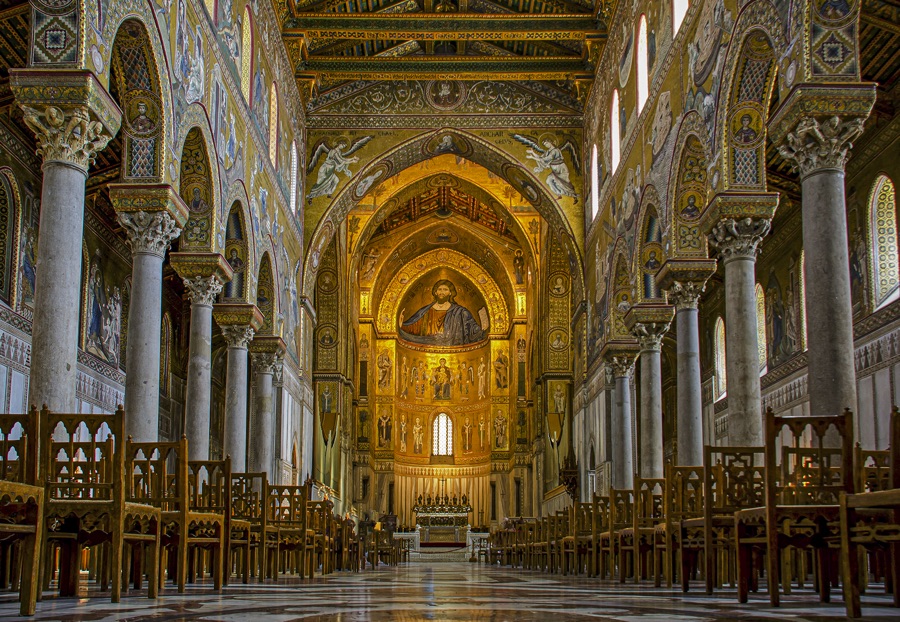
Stopping at the centre of the main nave invites us on a kaleidoscopic journey through time, starting from the eight arches that follow one another on each side of the longitudinal body.

They are supported by eighteen columns, which are equal in height with the exception of the two columns near the entrance and the second column on the right. The balanced succession of grey granite, imbued with reddish hues, which forms the monolithic shaft of seventeen columns contrasts with the grey cipollino marble with green veins that forms the first column to the right of the western entrance, added in 1356 and relocated to its current position in the first third of the 19th century.
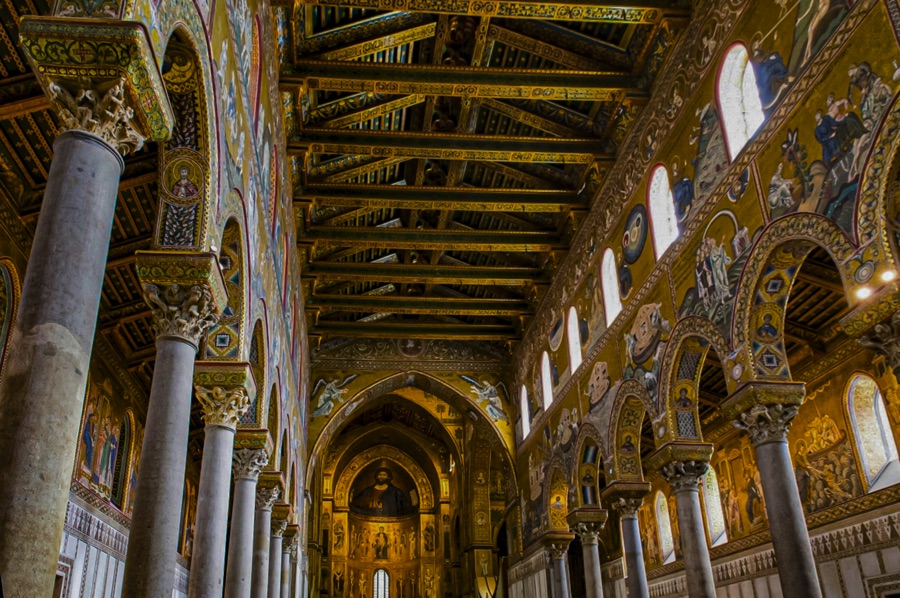

This order, which was not left to chance and in which every slightest difference in the height of the shafts was compensated for, with tacit complicity, by the size of the plinths , must have appeared even more uniform during the reign of William II .

DOOR AND GATEWAY TO PARADISE
The Monreale cathedral doorway is an example of the reuse of ancient marble. It is made of spoliated marble: Greek marble, Parian marble and Proconnesian marble. It is cusp-shaped and has four ogival rings. It is richly decorated with bands of figurative, geometric and other abstract motifs in relief, and opus sectile inlays with star-shaped polygons. Set into this ancient portal is the bronze door, the work of the artist Bonanno Pisano, who had already distinguished himself in Pisa, where he designed the lost bronze doors of Pisa Cathedral. The authorship of the Monreale work is also indicated by the inscription: “Anno / D(omi)ni / MCL / XXXVI / i(n)dictio(n)e / III Bon(n)a / nus ci / vis Pis / anus / me fe / cit”. The bronze door of Monreale, with two doors carved in relief or agemina, was cast and then arrived on site in 1185 (1186 according to the index). In the 44 panels, scenes from the Old Testament are depicted in the five lower registers, with scenes from the New Testament in the five upper registers. Being a kind of Biblia pauperum, the two registers are united by the representation of the twelve prophets. Further panels are found at the bottom with pairs of lions and griffins facing each other and at the top with Mary and Christ in glory. The gate is also known as the Gates of Paradise, and going through it meant reaching the splendour of the Heavenly Jerusalem and being able to enjoy the beauty and magnificence of the mosaics. Like most of the bronze doors of the time, the one designed by Bonanno was probably rectangular, but was adapted to the doorway with a pointed-arch crowning. This could be the reason why the upper representations of the Madonna in Glory and Christ in Glory are partly hidden by the doorway. The portal was therefore made before the Pisano panels.

In this organic perspective that envelops the senses as soon as you cross the threshold of the Gate of Paradise ,  created by Bonanno Pisano , we can’t help but focus on the composite acanthus leaf decorations of the Corinthian capitals , unexpectedly interrupted by the dynamism of the figured capitals.They are larger than the first ones and are arranged, in no particular order, at the top of columns which are smaller in diameter. They are distinguished by the presence of imagines clipeatae surrounded by cornucopias.

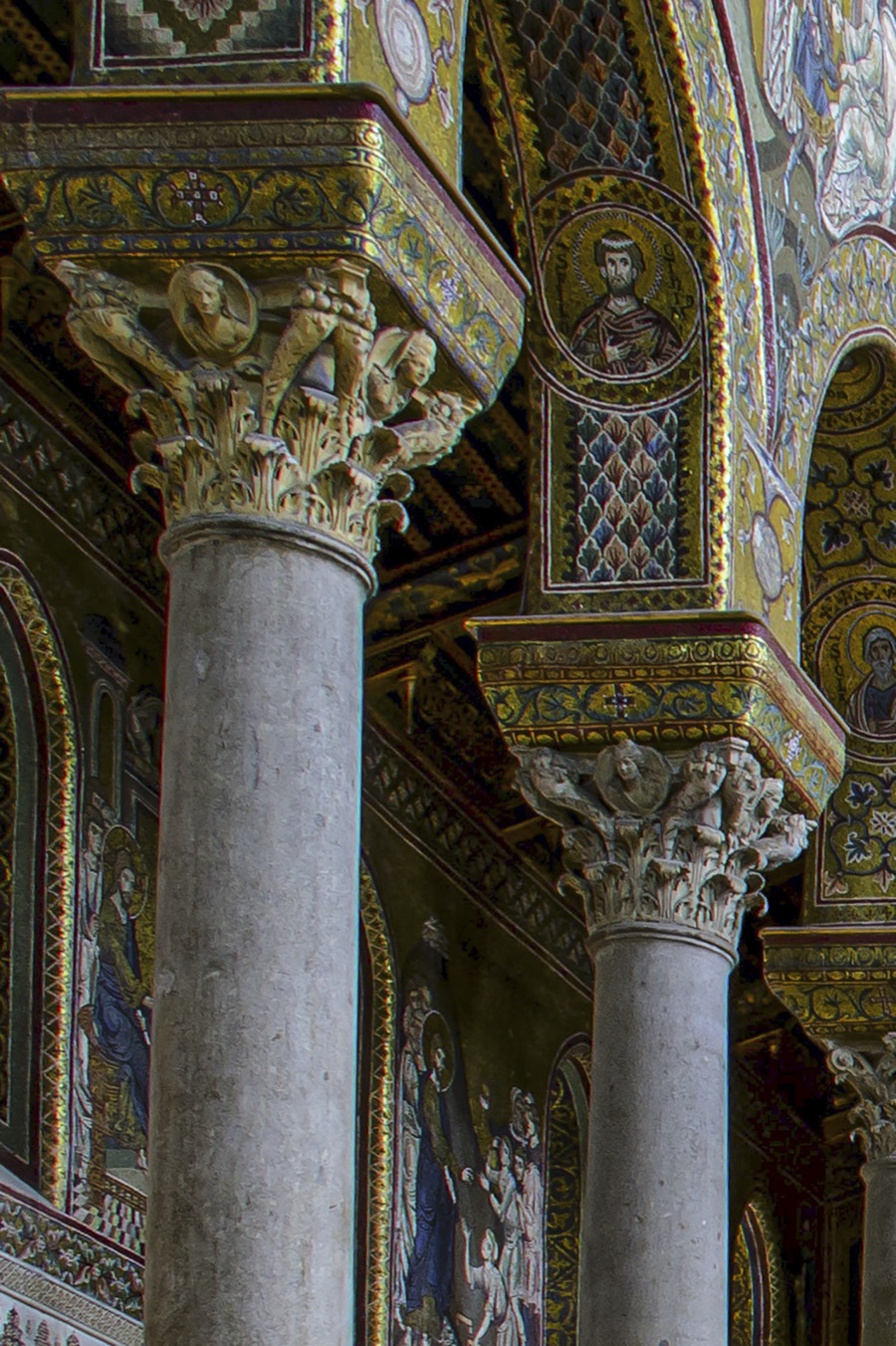
The choice, which follows the Monreale Cathedral tradition of a column-lined basilica, was already used in Cefalù Cathedral, which was used as a template for the layout and proportions of the nave. The model is based on an architectural tradition dating back to early Christian times and revived in the 11th century in Benedictine and Cluniac religious buildings.
The presence of spolia columns and capitals, reused in the Workshop, is a tangible sign of the desire of the times, for the king and the clergy, to emphasise the cultural advent of the Christian West.

The cemetery of kings

The liturgical spaces of the protesis and the diaconicon

The chystro: a place between earth and sky

Tempus fugit: a strategic project implemented in a short period of time

The chapel of St. Benedict

Artistic elements in Peter’s ship

The transformations of the hall through the centuries

The lost chapel

Interior decorations

A space between the visible and the invisible

The chapel of san Castrense: an important renaissance work

Thirteenth-century iconography decorates the nave’s wooden ceiling, designed with new solutions

The mosaics of the apses

Ecclesia munita

The links between the hauteville family and the monastic orders in Sicily

The Gualtiero Cathedral

The Kings’ Cathedrals

The Bible carved in stone

The construction of Monreale Cathedral: between myth and history

Under the crosses of the Bema

The medieval city amidst monasticism and feudal aristocracy

The dialogue between the architectures of the monumental complex

Mosaic decoration

A mixture of styles pervades the floor decorations

The side aisles

From the Mosque to the Cathedral

The plasticism of the main portico and Bonanno Pisano’s Monumental Bronze Door

A chapel by an unknown designer based on repeated symmetries

The cultural substrate through time

Biblical themes enlivened by the dazzling light of the stained – glass windows overlooking the naves

The towers and the western facade

A Northern population

Norman religious architecture with islamic influences in Sicily

The area of the Sanctuary

Two initially similar towers, varied over time

The chapel of the crucifix: an artistic casket based on a previous model

From the main gate to the aisles: an invitation to a journey of faith

A tree full of life

Gardens and architecture as a backdrop to the city of Palermo

A controversial interpretation

Transformations over the centuries

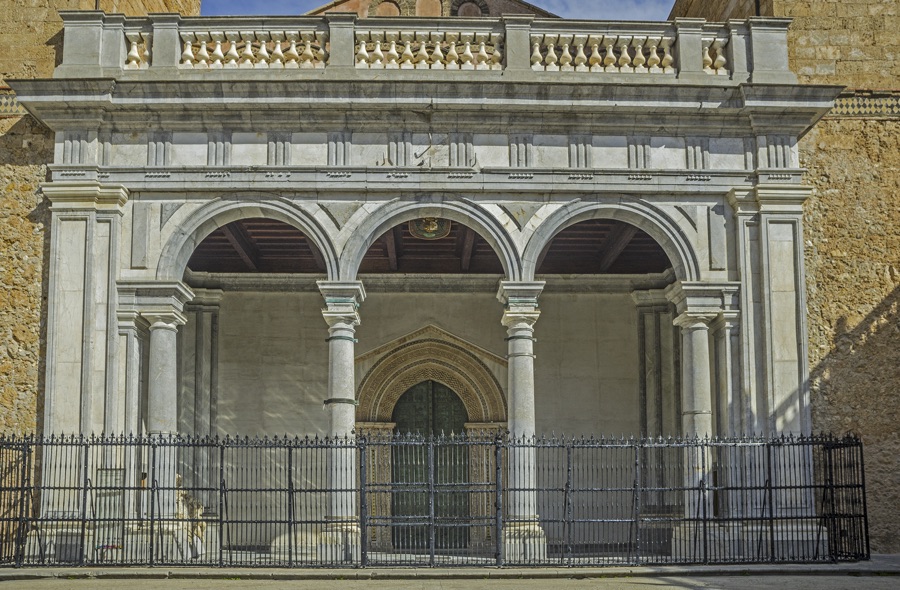
The side Portico: a combination of elegance and lightness of form

Roger II’s strategic design

The original design

Palermo: the happiest city

The towers facing the facade used as bell towers

A remarkable ceiling

The Great Restoration

A new Cathedral

The mosaics of the presbytery

The Chapel of the Kings

Cefalù: settlement evidence through time

A cloister of accentuated stylistic variety

A compositional design that combines nordic examples with new artistic languages, over the centuries

The stone bible

Characteristics of religious architecture in the romanesque period

The senses tell Context 1

The columns of the nave: the meticulous study of the overall order

Survey of the royal tombs

Porphyry sarcophagi: royalty and power

Roger II of hauteville: a sovereign protected by God

Squaring the circle

The marble portal: an intimate dialogue between complex ornamental aspects and formal structure

The Chapel of St. Mary Magdalene

The Cathedral over the centuries

The paradisiacal “Conca d’oro” that embraces Palermo: a name with countless faces through time

The southern portico

The architectural modifications ti the cathedral building after the death of Roger II and the transformations of the cloister

The balance between architecture and light

The beginning of the construction site

The Great Presbytery: a unique space for the cathedral

A polysemy of high-level artistic forms and content

A palimpsest of history

Layers of different cultures decorate the external apses

The Cefalù cathedral: a construction yard undergoing a change between a surge of faith and control over the territory

The chorus: beating heart of the cathedral

Worship services

The Virgin Hodegetria

The king’s mark

The rediscovered chapel

The longest aisle

The decorated facade

Beyond the harmony of proportions