Palermo Cathedral
The Context 1

A Northern population

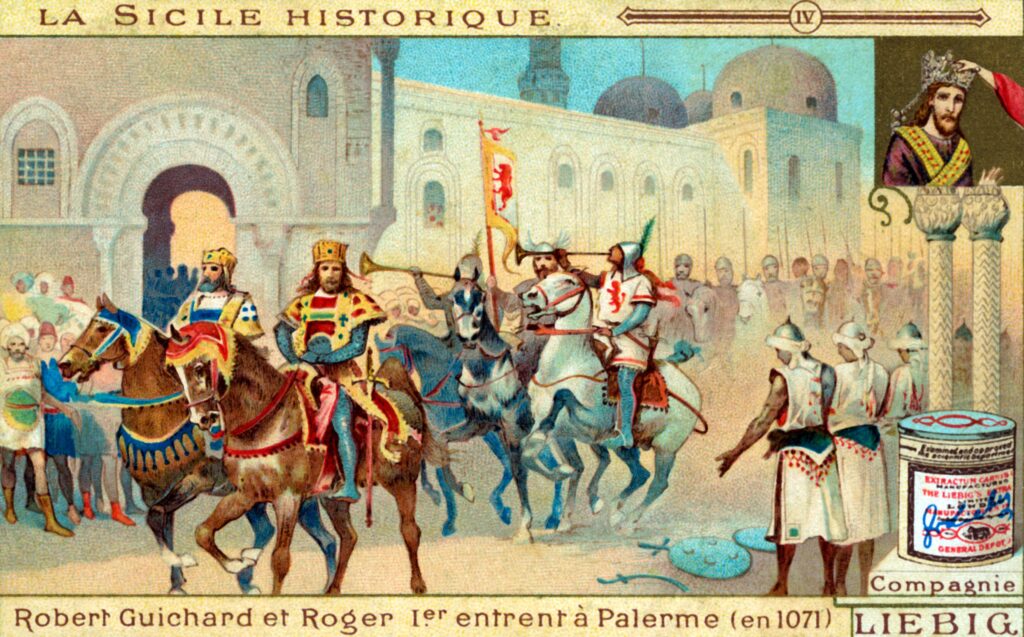
The Normans, a Viking population from Normandy, landed in Messina in 1061 and conquered Palermo in 1071 under the leadership of two great leaders of the Altavilla family: Robert Guiscard and his brother the Great Count Roger found a prosperous and rich city.From here they continued their quest to conquer the island, which lasted about 30 years, until 1091, when the city of Noto, the last Muslim stronghold in Sicily, was conquered.


The military operation was preceded by a pact, known as the Treaty of Melfi , in which Pope Nicholas II gave Robert Guiscard, of the Norman Altavilla family , the mandate to proceed to conquer the regions of southern Italy, giving him the title of Duke of Apulia, Count in Sicily and Duke of Calabria, even before the conquest of such territories.

The Norman presence in Sicily was not accidental, it was strongly backed by the Church, to somehow balance the Byzantine presence in Southern Italy and free Sicily from the Muslim occupation, which had lasted over 250 years, thus being able to bring Christianity back to the island.

The mosaics of the presbytery

Interior decorations

The senses tell Context 1

The chorus: beating heart of the cathedral

The original design

The lost chapel

A chapel by an unknown designer based on repeated symmetries

Roger II of hauteville: a sovereign protected by God

Ecclesia munita

The side Portico: a combination of elegance and lightness of form

Cefalù: settlement evidence through time

Palermo: the happiest city

The paradisiacal “Conca d’oro” that embraces Palermo: a name with countless faces through time

Survey of the royal tombs

The dialogue between the architectures of the monumental complex

A controversial interpretation

Tempus fugit: a strategic project implemented in a short period of time

The chapel of St. Benedict

Biblical themes enlivened by the dazzling light of the stained – glass windows overlooking the naves

Roger II’s strategic design

The towers and the western facade

The construction of Monreale Cathedral: between myth and history

The side aisles

A cloister of accentuated stylistic variety

From the Mosque to the Cathedral

Norman religious architecture with islamic influences in Sicily

The columns of the nave: the meticulous study of the overall order

The Great Presbytery: a unique space for the cathedral

The rediscovered chapel

Squaring the circle

Layers of different cultures decorate the external apses

Characteristics of religious architecture in the romanesque period

The decorated facade

The chapel of san Castrense: an important renaissance work

The cemetery of kings

Thirteenth-century iconography decorates the nave’s wooden ceiling, designed with new solutions

Mosaic decoration

A Northern population

Worship services

Under the crosses of the Bema

A palimpsest of history

The plasticism of the main portico and Bonanno Pisano’s Monumental Bronze Door

The mosaics of the apses

The beginning of the construction site

Beyond the harmony of proportions

The cultural substrate through time

Transformations over the centuries

A space between the visible and the invisible

Artistic elements in Peter’s ship

The Virgin Hodegetria

A polysemy of high-level artistic forms and content

The Chapel of St. Mary Magdalene

A tree full of life

A remarkable ceiling

The marble portal: an intimate dialogue between complex ornamental aspects and formal structure

The towers facing the facade used as bell towers

The architectural modifications ti the cathedral building after the death of Roger II and the transformations of the cloister

A new Cathedral

The king’s mark

The chystro: a place between earth and sky

Gardens and architecture as a backdrop to the city of Palermo

The Cathedral over the centuries

The southern portico

Two initially similar towers, varied over time

The longest aisle

The Gualtiero Cathedral

A mixture of styles pervades the floor decorations

The Great Restoration

The Cefalù cathedral: a construction yard undergoing a change between a surge of faith and control over the territory

From the main gate to the aisles: an invitation to a journey of faith

Porphyry sarcophagi: royalty and power

The stone bible

The chapel of the crucifix: an artistic casket based on a previous model

The transformations of the hall through the centuries

The medieval city amidst monasticism and feudal aristocracy

The Chapel of the Kings

The links between the hauteville family and the monastic orders in Sicily

The Kings’ Cathedrals

The area of the Sanctuary

The liturgical spaces of the protesis and the diaconicon

The balance between architecture and light

A compositional design that combines nordic examples with new artistic languages, over the centuries

The Bible carved in stone