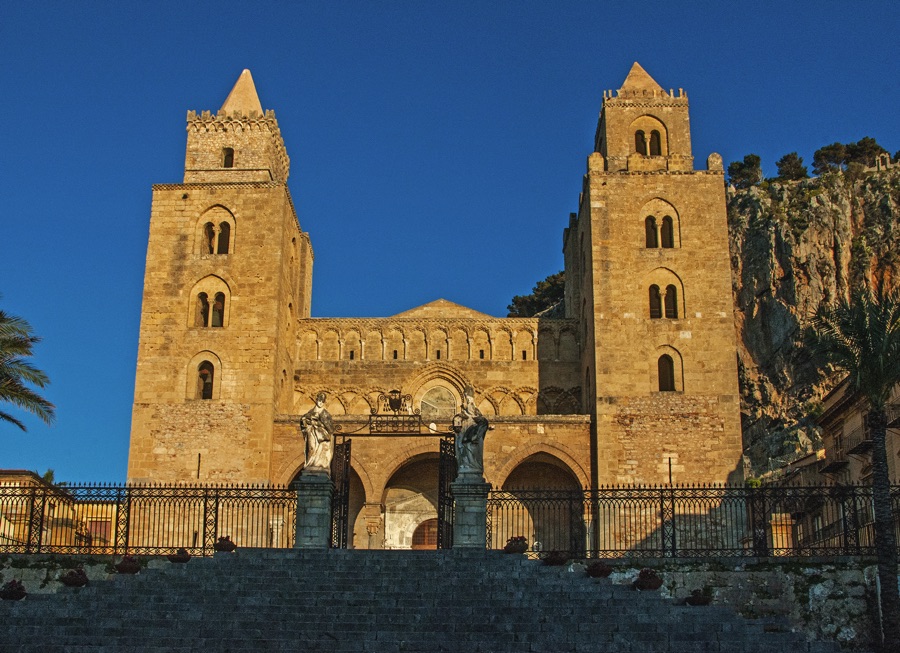
 At first glance, the western façade of the Cathedral has a compositional structure that is independent from the rest of the building, functioning as a transverse link to the two towers accessible from different heights.
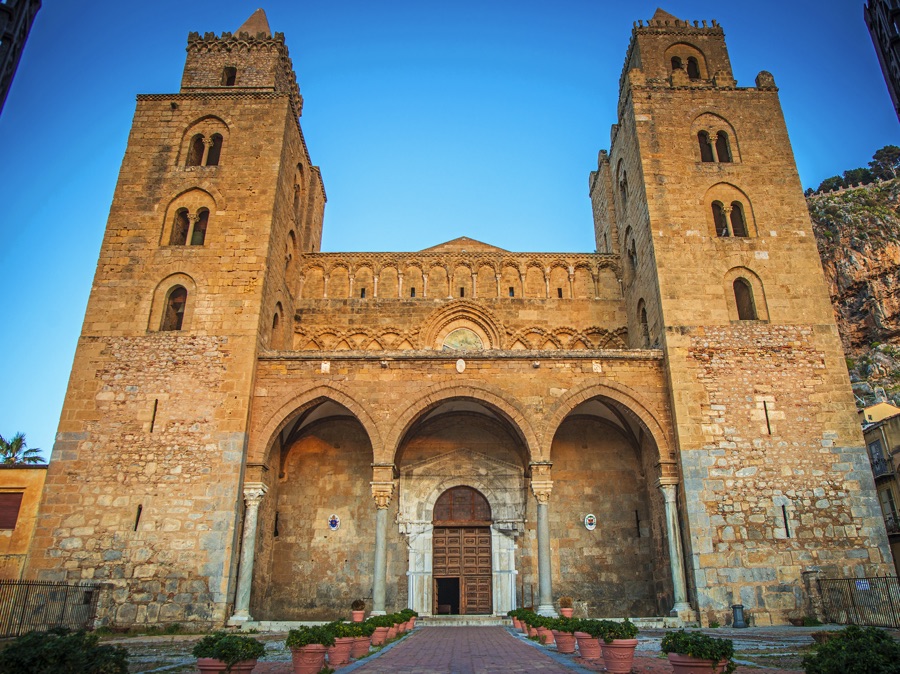 The massive vertical momentum of the latter and the fact that they belong to the Norman period, however, still conceals an Islamic military reference to the presence of tall square parallelepipeds crowned by smaller structures. Their shape only gives this part of Cefalù Cathedral an Arabesque profile, to the extent that comparisons can be made with the minarets of
Sfax and Kairouan
The massive vertical momentum of the latter and the fact that they belong to the Norman period, however, still conceals an Islamic military reference to the presence of tall square parallelepipeds crowned by smaller structures. Their shape only gives this part of Cefalù Cathedral an Arabesque profile, to the extent that comparisons can be made with the minarets of
Sfax and Kairouan
 . Among the elements attributable to Kairouan, in addition to the already mentioned square plan, we cannot overlook the attention to the geometric relationship between base and height, the presence of the lantern, the azrî crowned by the battlements at the top and the terrace in the middle of which it stands. The interior of the towers also hides spaces with structures present in the minarets of the western area, such as the presence of rooms arranged at various heights connected by spiral staircases, strategically linked to the system of pathways that ran along the perimeter of the building. However, apart from the latter explicitly Hispano-Maghreb references, the towers of the Cefalù Cathedral can be considered one of the examples of
Romanesque churches bell towers
. Among the elements attributable to Kairouan, in addition to the already mentioned square plan, we cannot overlook the attention to the geometric relationship between base and height, the presence of the lantern, the azrî crowned by the battlements at the top and the terrace in the middle of which it stands. The interior of the towers also hides spaces with structures present in the minarets of the western area, such as the presence of rooms arranged at various heights connected by spiral staircases, strategically linked to the system of pathways that ran along the perimeter of the building. However, apart from the latter explicitly Hispano-Maghreb references, the towers of the Cefalù Cathedral can be considered one of the examples of
Romanesque churches bell towers
 .
.