In the Cathedral of Monreale, there is a particular spatial composition of the
presbyteral area
 , consisting of a double volume, in some cases also called double
transept
.
, consisting of a double volume, in some cases also called double
transept
.
It is this typology, unique in Sicily for Norman churches, which also distinguished the
Palermo Cathedral
 , in its original layout, now appreciable only from the view of the external volumes.
The space of the sacred area of the Sanctuary is divided into two large rooms, distinct from the
church hall
 because of its higher position, connected to it by some steps.
The whole area is generically called the
Great Chancel
, and is effectively divided into three distinct parts: the larger central part, closer to the hall, is more properly called the
Presbytery
.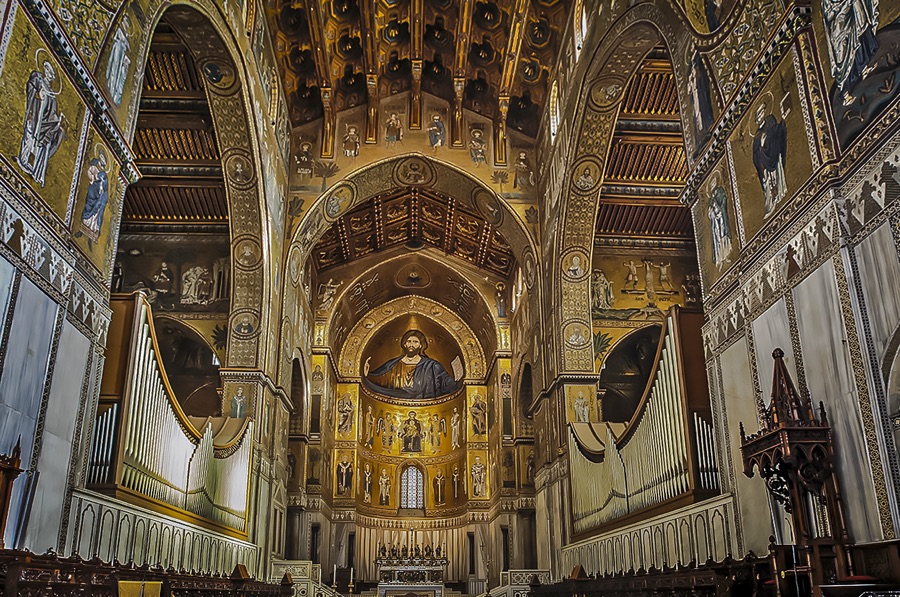 This is delimited by two narrow transverse spaces: the
Anti-Presbytery Floor
, towards the hall, and the
Post-Presbytery Floor
, connecting the side apses with the
Tribuna maggiore
of the
central apse
. These spaces in Palermo Cathedral are identified with the ancient name of
Titulus
, corresponding to the presbytery of Monreale and
Antititulus
with the space of the Post Presbytery. In Palermo Cathedral, the Titulus was the area designated for the Cathedral’s
Canons Titular
This is delimited by two narrow transverse spaces: the
Anti-Presbytery Floor
, towards the hall, and the
Post-Presbytery Floor
, connecting the side apses with the
Tribuna maggiore
of the
central apse
. These spaces in Palermo Cathedral are identified with the ancient name of
Titulus
, corresponding to the presbytery of Monreale and
Antititulus
with the space of the Post Presbytery. In Palermo Cathedral, the Titulus was the area designated for the Cathedral’s
Canons Titular
 , who took their place in the
choir
. The bishop’s chair and the royal seat were located in this space. The cemetery area with the
sarcophagi
of the kings and bishops were located on either side of the Titulus. Similarly, and still visible today, in Monreale, the choir is located in the space of the presbytery and the adjoining side parts are dedicated to containing the royal sarcophagi.
, who took their place in the
choir
. The bishop’s chair and the royal seat were located in this space. The cemetery area with the
sarcophagi
of the kings and bishops were located on either side of the Titulus. Similarly, and still visible today, in Monreale, the choir is located in the space of the presbytery and the adjoining side parts are dedicated to containing the royal sarcophagi.