Monreale Cathedral
the cathedral's exterior

The dialogue between the architectures of the monumental complex

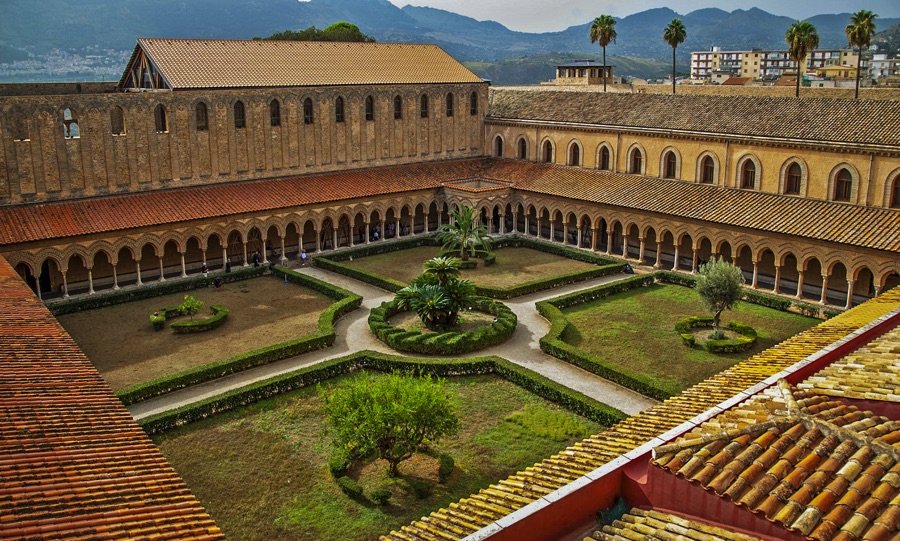
Cloister garden
The central courtyard of the cloister is canonically defined as a garden, in which no flower essences are planted because they are deciduous; instead, the flowers are sculpted in the capitals, in the eternal nature of the stone. The garden, according to tradition, is divided into four parts where four symbolic trees are planted, the fig, the pomegranate, the olive and the palm. The first two plants, the fig and the pomegranate, refer to the Old Testament, as they are considered to be historical. The fig tree is located in the south-east and symbolises the Garden of Eden. The pomegranate tree is located in the north-east the garden of the Song of Songs. For the New Testament, the presence of symbolic plants is notable. The Olive tree, an allegory of Gethsemane and the future Easter, is located to the north-east, while the Palm tree, in the garden of the Apocalypse, is located to the south-west.

Since its origin, the Monreale Cathedral was connected to all the surrounding buildings, from the cloister, adjacent to the right side of the church to the south, to the the monastery , whose northern wing touched it.

The rich external decoration of the Cathedral’s three east-facing semicircular apses was linked to the eastern façade of the Royal Palace, echoing its majestic compositional rhythm.
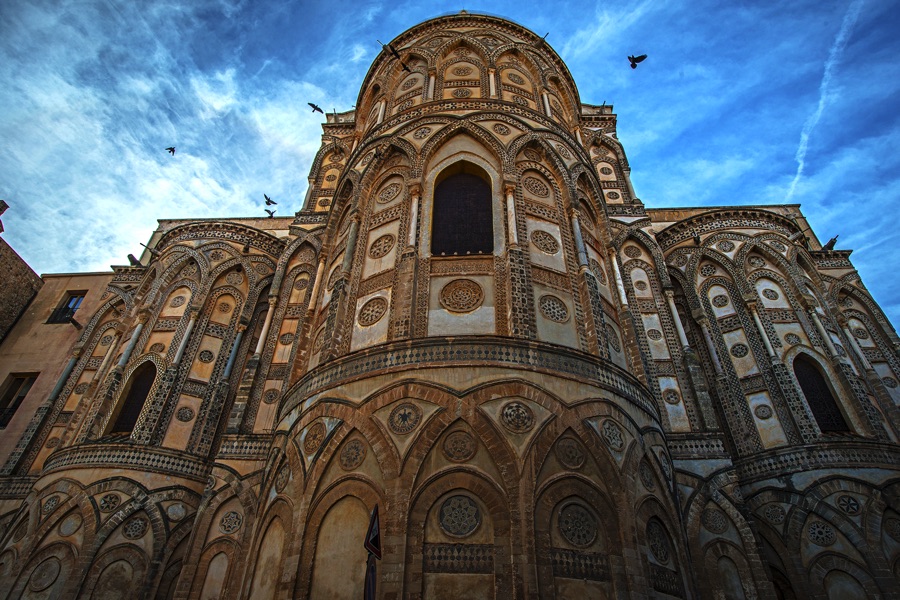
decoration of the apses
The three semicircular external apses of the cathedral, facing east, are characterized by a rich and original decoration. The orderly ensemble of the many mouldings that make up, with a balanced trend, the outer walls of the apses is formed by ogival arches, lower in height, which intersect each other on the same axes with a sinuous rhythm. The contrast of colours is made even more vivid by the use of brown limestone, grey-black lava tuff from Vesuvius, and red bricks used in the thin horizontal bands, contrasting with the warm golden brown hue of the background. The presence of small columns underneath the pointed arches, decorated with capitals of simple workmanship that are inserted between the varied geometric scores, marks the upward movement of the architectural elements of the apses, both inside and outside.

The decision to emphasise the ornamental composition of the east-facing architecture was prompted by the desire to enhance the noblest part of the building, located in the sanctuary area.
The orderly ensemble of the many mouldings that make up the outer walls of the apses is formed by ogival arches , lower in height, which intersect each other on the same axes with a sinuous rhythm, almost as if to compose a silent melody. The contrast of colours seems to form the musical accompaniment, animated by the notes of the brown limestone, the grey-black lava tuff from Vesuvius, and the red bricks used in the thin horizontal bands. Softening this varied concert of colours is the warm golden-brown hue of the background.

The presence of small columns underneath the pointed arches, decorated with capitals of simple workmanship that are inserted between the varied geometric scores, marks the upward movement of the architectural elements of the apses, both inside and outside.
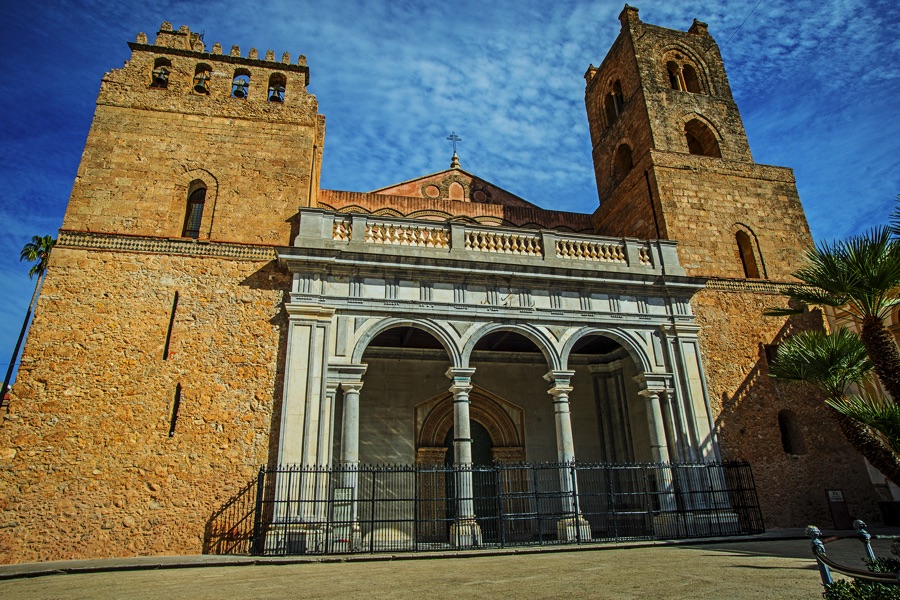
Compared to the richness of the three apses, the rest of the building, from the transept and the naves to the main west-facing façade, has a simple and austere volume, with linear wall decorations reproducing the classic sequence of blind arches. They modulate, in a regular rhythm, the lateral façades located to the south and north. A more articulated decoration, somewhat reminiscent of the homologous façade of Cefalù Cathedral , can be found on the western wall where, above the marble portal, there is a large window within the decorative scheme. It is made up of intersecting ogival arches, leaving room for tondos containing various geometric designs, highlighted by two-tone inlays.


Characteristics of religious architecture in the romanesque period

The lost chapel

The beginning of the construction site

Cefalù: settlement evidence through time

The transformations of the hall through the centuries

The mosaics of the presbytery

Roger II of hauteville: a sovereign protected by God

A mixture of styles pervades the floor decorations

The Gualtiero Cathedral

The chapel of the crucifix: an artistic casket based on a previous model

The decorated facade

The cemetery of kings

The chorus: beating heart of the cathedral

A palimpsest of history

Under the crosses of the Bema

The towers and the western facade

The medieval city amidst monasticism and feudal aristocracy

Mosaic decoration

The king’s mark

Thirteenth-century iconography decorates the nave’s wooden ceiling, designed with new solutions

A controversial interpretation

The dialogue between the architectures of the monumental complex

The original design

A space between the visible and the invisible

The Cathedral over the centuries

Survey of the royal tombs

The Great Presbytery: a unique space for the cathedral

Gardens and architecture as a backdrop to the city of Palermo

The columns of the nave: the meticulous study of the overall order

The plasticism of the main portico and Bonanno Pisano’s Monumental Bronze Door

The stone bible

Transformations over the centuries

A cloister of accentuated stylistic variety

A chapel by an unknown designer based on repeated symmetries

The construction of Monreale Cathedral: between myth and history

The cultural substrate through time

A remarkable ceiling

The longest aisle

From the main gate to the aisles: an invitation to a journey of faith

The links between the hauteville family and the monastic orders in Sicily

The senses tell Context 1

The towers facing the facade used as bell towers

The rediscovered chapel

The paradisiacal “Conca d’oro” that embraces Palermo: a name with countless faces through time

Artistic elements in Peter’s ship

The Great Restoration

The area of the Sanctuary

The balance between architecture and light

The Bible carved in stone

The Chapel of St. Mary Magdalene

A Northern population

The liturgical spaces of the protesis and the diaconicon

A compositional design that combines nordic examples with new artistic languages, over the centuries

The Virgin Hodegetria

The chystro: a place between earth and sky

The southern portico

Worship services

Tempus fugit: a strategic project implemented in a short period of time

A tree full of life

A new Cathedral

The Kings’ Cathedrals

A polysemy of high-level artistic forms and content

The marble portal: an intimate dialogue between complex ornamental aspects and formal structure

Biblical themes enlivened by the dazzling light of the stained – glass windows overlooking the naves

Norman religious architecture with islamic influences in Sicily

From the Mosque to the Cathedral

The Cefalù cathedral: a construction yard undergoing a change between a surge of faith and control over the territory

Squaring the circle

The Chapel of the Kings

Beyond the harmony of proportions

The chapel of san Castrense: an important renaissance work

Porphyry sarcophagi: royalty and power

Layers of different cultures decorate the external apses

The side Portico: a combination of elegance and lightness of form

Palermo: the happiest city

The architectural modifications ti the cathedral building after the death of Roger II and the transformations of the cloister

Interior decorations

Roger II’s strategic design

Ecclesia munita

The mosaics of the apses

The side aisles

Two initially similar towers, varied over time

The chapel of St. Benedict