The context

The underwater morphological elements of the Aeolian Islands

The processes that lead to the formation of an island in its final configuration are quite complex. They are the result of continuous “building” activity, alternating, however, with long periods of dormant volcanic activity, even lasting around tens of thousands of years. During these moments of pause in the volcanic island’s expansion, called stasis, “destructive” processes occur. These are erosive phenomena caused by the main atmospheric agents, such as the sea and the wind.
Sea erosion in the presence of strong slopes can create super low-incline platforms: in fact, the sea slowly erodes at the same height, digging a “wave-cut notch” and making everything above unstable, until it collapses. The end result is that the escarpment is moved back in a parallel manner, which does not change its profile, and a platform forms at its base.
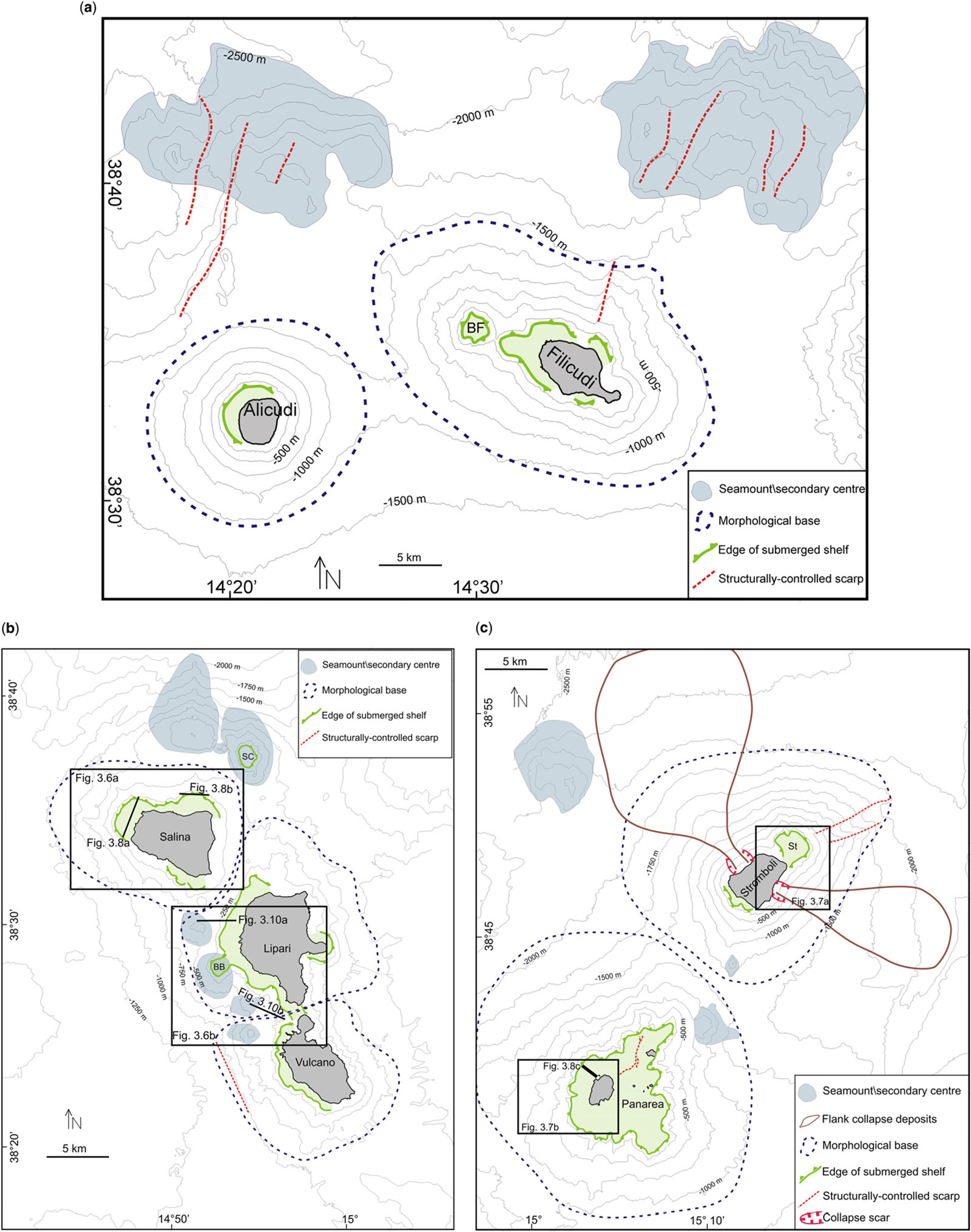
Carta batimetrica delle Isole Eolie
This pictur shows how these platforms formed in the western and northern part of each island. This was caused by the dominant winds and seas in the Aeolian Islands. The most frequent and most energetic are those of tramontane from the north, mistral from the north-west and ponente from the west. For these reasons all the main ports on each island are on the eastern side, which is protected from the west winds by the mountain.

The hidden part of the Aeolian Islands

Stromboli, the volcano that breathes

The stacks of Panarea

Filicudi: small island, big history

Salina, the green island with twin mountains

The senses tell The summit craters

Panarea and its history

How pumice is formed

Tsunamis: a not uncommon phenomenon in Stromboli

Lipari, where history intertwines with volcanoes to create archaeology

The Aeolian Islands, where volcanology was born

The senses tell The Sciara del Fuoco

The underwater morphological elements of the Aeolian Islands

The polis of the living and the necropolis of the dead

The underwater fumarolic activity of Lisca Bianca

Panarea, where sea and volcanoes become sculptors

Vulcano, the youngest of the Aeolian works of art

Seven islands, dozens of volcanoes

The Sciara del Fuoco

“Vulcanian” eruptions

“Strombolian” activity in the place where its definition was born

Pollara, between poetry and beauty

The Village of Capo Graziano

Between brush strokes of sulphur and clouds of steam: the fumaroles of the port of Vulcano

Filicudi, a submerged paradise

Myths and legends about volcanoes

The summit craters

The senses tell The Village of Capo Graziano

The pure white of the pumice quarries

The 2002-03 eruption

The malleability of Vulcano’s mud

The prehistoric village of Cala Junco

Lipari Castle, “fused” with the lava

The ancient production of salt

The salt lake of Lingua

Malvasia delle Lipari DOC

The senses tell The Stacks of Panarea

Alicudi, where time has stood still

Where do Vulcano’s gases come from?

Lipari at the centre of Mediterranean history

The Cathedral of Lipari and the Norman Cloister of the Benedictine Monastery

The Gran Cratere of the Fossa: when the volcano becomes a sculptor

Volcanoes as a natural art form

The Thermal Baths of Saint Calogerus

The senses tell The Pumice Quarries of Lipari

Stories of the sea and shipwrecks. The wrecks of the Aeolian Islands

The senses tell The salt lake of Lingua

At the heart of trade in history