Stromboli

The Sciara del Fuoco

The summit craters of Stromboli are an incredible experience, but they are not suitable for everyone. An excellent alternative to admiring Stromboli is to head for the Sciara del Fuoco. From the centre of the village of Stromboli follow the only lane in a counter-clockwise direction and climb up to an altitude of 200 metres. Here you will face the south-west flank of Stromboli towards an escarpment that descends with a 30° slope from the summit craters to the sea, universally known as the Sciara del Fuoco, a talus scree of fire.
It is where all the products of the summit crater explosions have accumulated over the last thousand years, especially lapilli and ash. As far as volcanic bombs are concerned, it is quite common, even during the day, to see glowing balls being thrown from the summit craters then beginning to roll down the Sciara del Fuoco until they reach the sea.
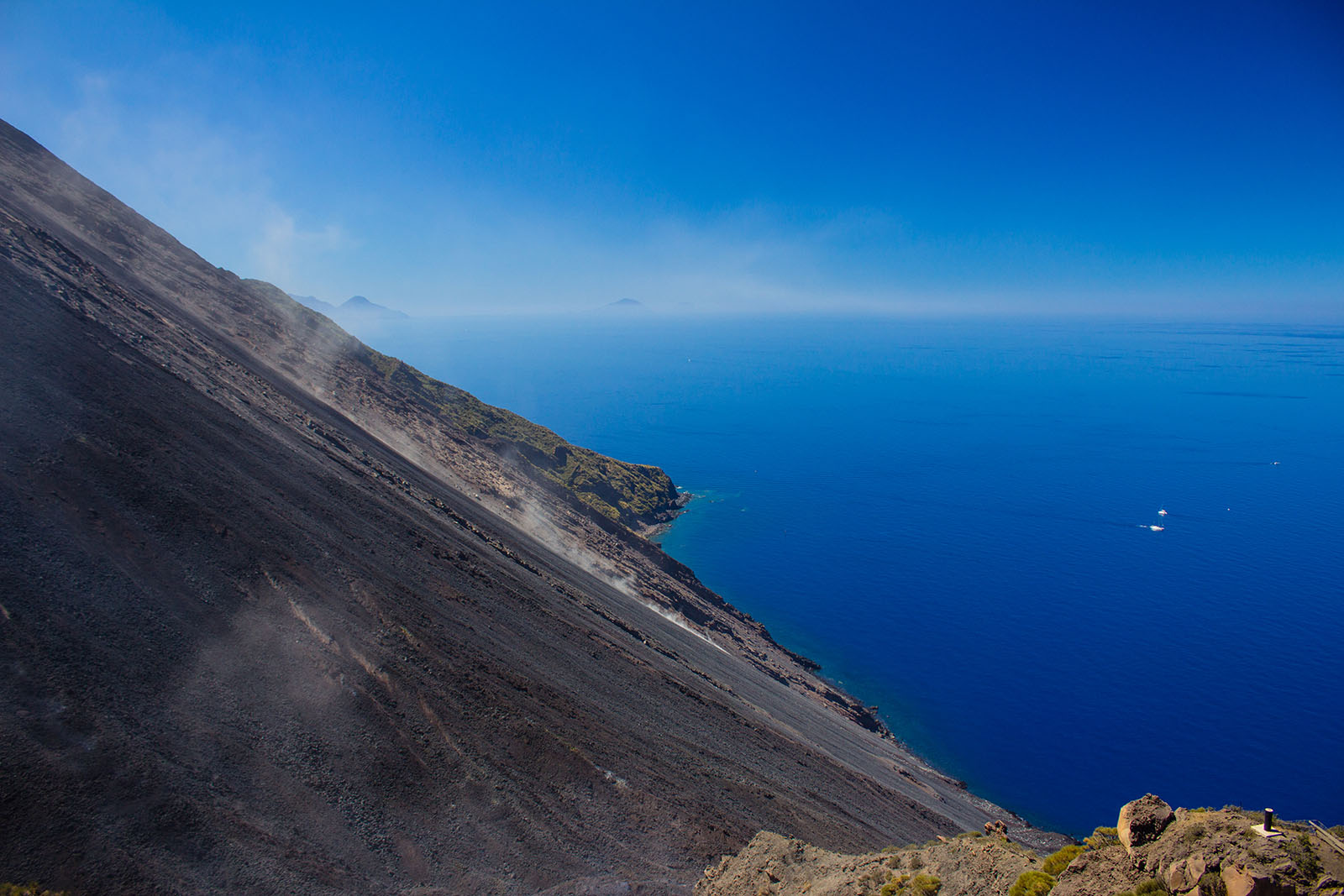
bombe rotolano sciara del fuocoAnother resting place is located 400 metres above sea level, the maximum limit to climb the volcano without being accompanied by a volcanological mountain guide. From here you will appreciate the beauty of the Sciara del Fuoco even more, and above all, you will have a better view of the north-west face of the summit craters.

Filicudi, a submerged paradise

The 2002-03 eruption

How pumice is formed

Myths and legends about volcanoes

The Cathedral of Lipari and the Norman Cloister of the Benedictine Monastery

The underwater morphological elements of the Aeolian Islands

The ancient production of salt

Stories of the sea and shipwrecks. The wrecks of the Aeolian Islands

Tsunamis: a not uncommon phenomenon in Stromboli

Volcanoes as a natural art form

The prehistoric village of Cala Junco

Stromboli, the volcano that breathes

The polis of the living and the necropolis of the dead

The Gran Cratere of the Fossa: when the volcano becomes a sculptor

Filicudi: small island, big history

Lipari at the centre of Mediterranean history

The senses tell The Pumice Quarries of Lipari

The senses tell The Stacks of Panarea

Panarea, where sea and volcanoes become sculptors

Seven islands, dozens of volcanoes

The Thermal Baths of Saint Calogerus

Malvasia delle Lipari DOC

The Sciara del Fuoco

Salina, the green island with twin mountains

“Vulcanian” eruptions

Between brush strokes of sulphur and clouds of steam: the fumaroles of the port of Vulcano

The senses tell The salt lake of Lingua

The senses tell The Sciara del Fuoco

“Strombolian” activity in the place where its definition was born

Lipari Castle, “fused” with the lava

The stacks of Panarea

The senses tell The summit craters

The Village of Capo Graziano

The senses tell The Village of Capo Graziano

The malleability of Vulcano’s mud

The pure white of the pumice quarries

At the heart of trade in history

Lipari, where history intertwines with volcanoes to create archaeology

The Aeolian Islands, where volcanology was born

The salt lake of Lingua

Alicudi, where time has stood still

Vulcano, the youngest of the Aeolian works of art

The hidden part of the Aeolian Islands

The underwater fumarolic activity of Lisca Bianca

The summit craters

Where do Vulcano’s gases come from?

Panarea and its history

Pollara, between poetry and beauty