Ortigia

Temple of Apollo

At the entrance to the island of Ortygia, the base of two columns and a part of the cella (shrine) form the monumental ruins of the Temple of Apollo, the oldest Doric temple in eastern Sicily.
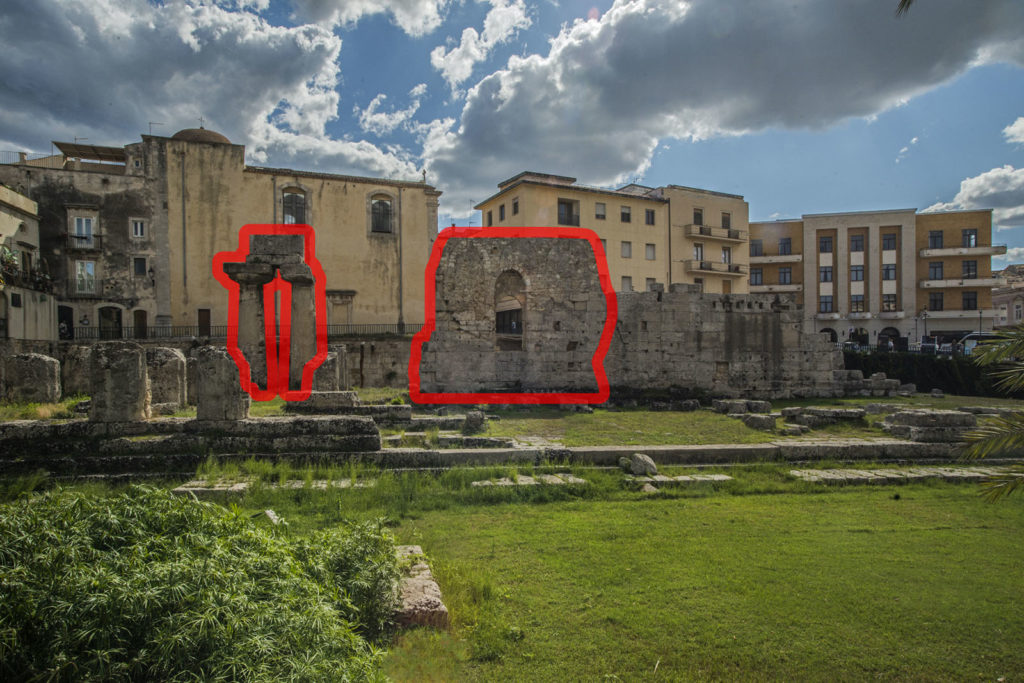
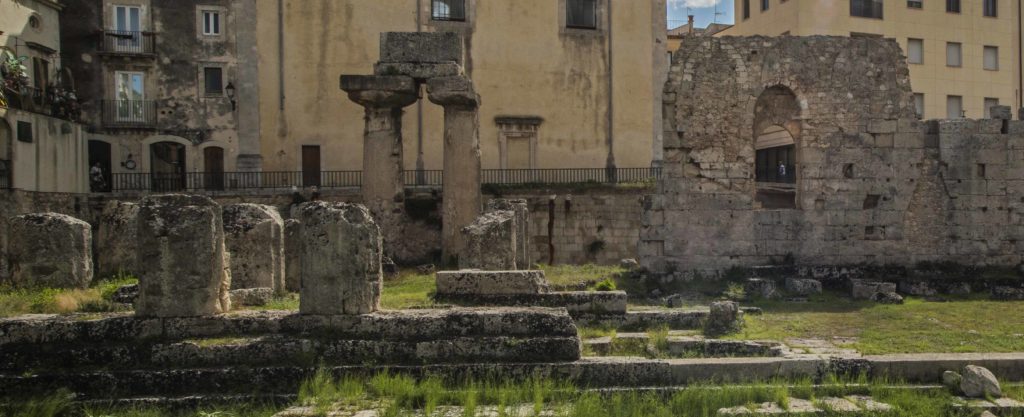
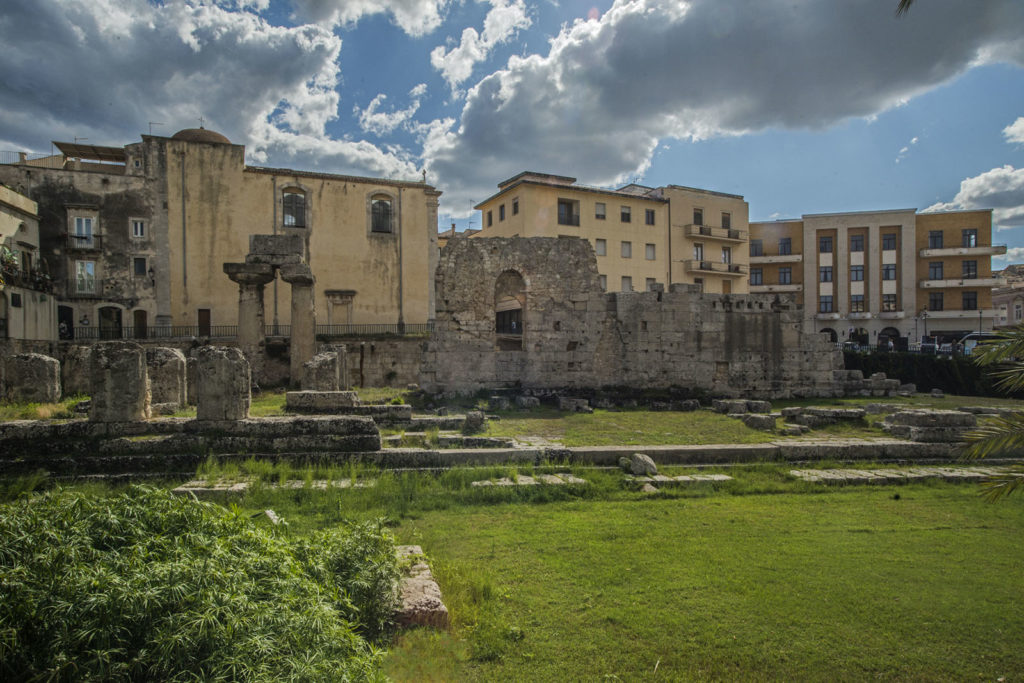
The building, dating from 565 BC, had a peristasis of six columns on the front and seventeen on the long side. Facing east, the building was preceded by a basement of four steps on which there was an engraving in Greek with a dedication to the god Apollo and the names of the temple’s creator and the columns’ builder. The cella (shrine), preceded by a vestibule, was divided into three naves by two rows of columns arranged in two levels.

The material used for the construction of the temple is the typical Syracusan limestone called “giuggiulena”. Since importing marble was too expensive, all the temples were built with local limestone, while only the noblest parts, like statues of the gods, were in marble.
The building’s roof was covered with terracotta slabs enriched with decorative motifs of a lively red and blue polychromy.
The rainwater holes were shaped like rosettes. Lastly, the temple’s pediment was decorated with a terrifying gorgon head with sharp tusks and a monstrous gaze, placed to guard the temple. A temenos, or enclosure, surrounded the temple, separating the sacred area from the secular space and housed an altar, inside which priests performed sacrifices to the gods.

The monument underwent numerous changes over the centuries: it was transformed into a Byzantine church, an Islamic mosque, a Norman church then was finally incorporated into a Spanish barracks.
Only in the 18th century did the birth of modern archaeology restore the ancient Greek place of worship to its original dignity.

The Gladiator performances

Ortygia. Venus rising from the waters of the port

Castello Maniace

Giudecca, the hidden Jewish heart of Syracuse

Traces of Christianity in Syracuse

Syracuse during the tyranny of Dionysius

The Greek Theatre of Syracuse

The Venationes

Byzantine Pantalica

Inside the Cathedral of Ortygia

The Jews, a wandering people

Where seas and civilisations meet

The Athenaion of the tyrant Gelon

Roman Syracuse, a military power thanks to the genius of Archimedes

The Spanish fortification

The Cathedral of Syracuse

The Senatorial Palace

Temple of Apollo

Neapolis from past to present

The Altar of Hieron II: Blood and fire place

The Ear of Dionysius and the Grotta dei Cordari

The catacombs of San Giovanni

The Roman Amphitheatre

The Euryalus Fortress

Crypt of San Marciano

Pantalica: where nature and history merge

The Culture of Pantalica

The Dionysian Walls: a masterpiece of Greek engineering

Piazza del Duomo, a sacred place of the ancient Greeks

The architecture of the Piazza

The functions of Castello Maniace

The Museion and the Grotta del Ninfeo

The Church of St. Lucia to the Abbey

Legends and magic echoes in the Latomie of Syracuse

King Hyblon’s kingdom: Pantalica, between history and legend

The Church of San Giovanni alle Catacombe

The cultural significance of tragedy