The Church of Santa Lucia alla Badia was originally a monastery.
The building was entirely destroyed by the earthquake of 1693 and later rebuilt at the behest of the Mother Abbess of the Cistercian order (A monastic order following the Rule of St. Benedict).
The Church and the Cistercian convent dedicated to St. Lucia had an important role in the city’s worship, both for their location in the heart of Ortygia, and for the feast of
St. Lucia in May
 , instituted to commemorate the patron saint’s miraculous intervention during the famine of 1646, when she led two ships loaded with grain into the port, putting an end to the Syracusans’ long hunger. The façade, facing the square, is made of light-coloured limestone and consists of two superimposed levels separated by a
trabeation
, instituted to commemorate the patron saint’s miraculous intervention during the famine of 1646, when she led two ships loaded with grain into the port, putting an end to the Syracusans’ long hunger. The façade, facing the square, is made of light-coloured limestone and consists of two superimposed levels separated by a
trabeation
 and a wrought iron
balcony
and a wrought iron
balcony
 with a balustrade with curved balusters.
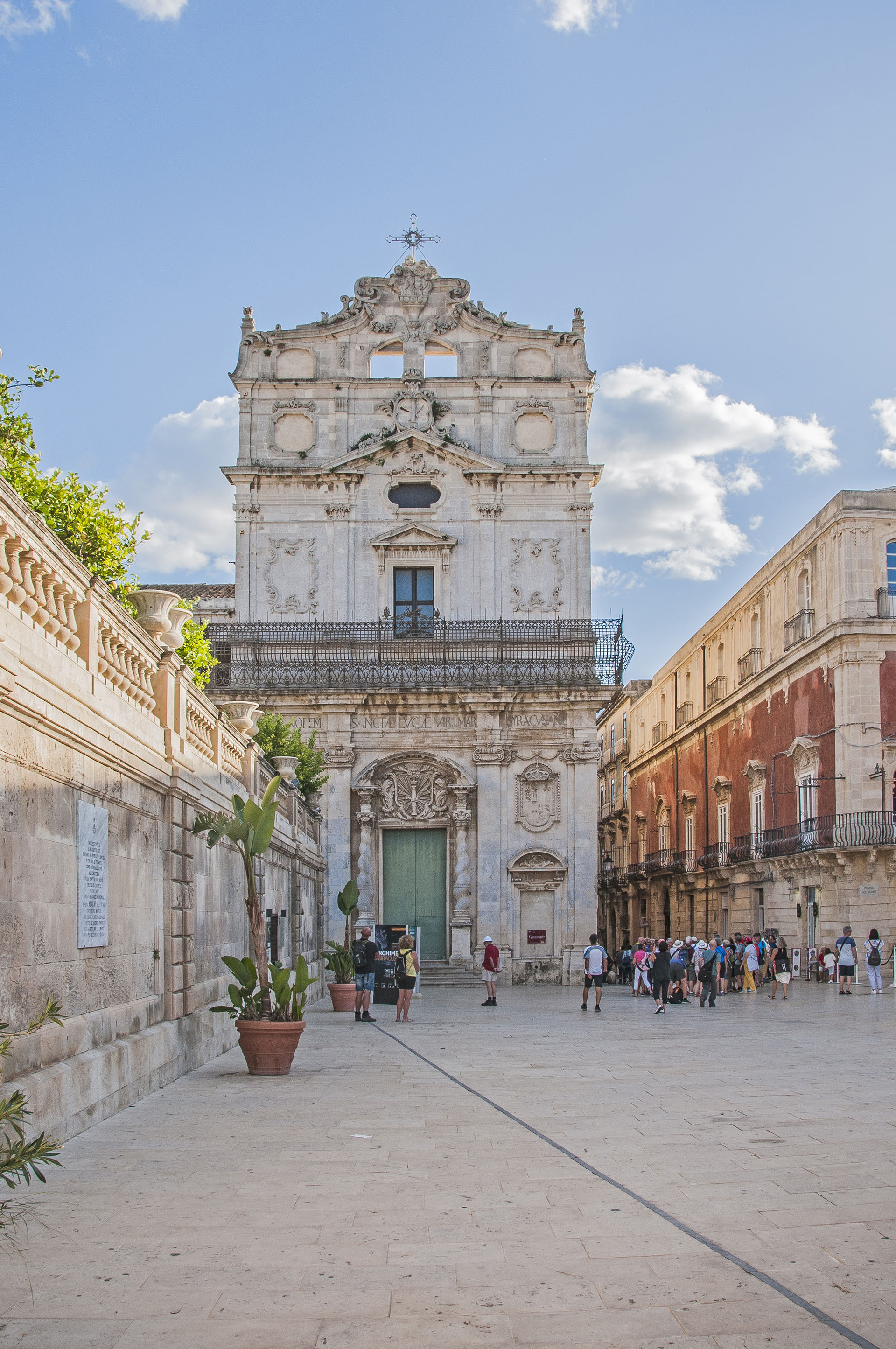 The lower level has a sumptuous Baroque portal flanked by
Solomonic columns
supporting the pediment, decorated with symbols of the Saint’s martyrdom. On the two side sections, enclosed within cornices, stand the coats of arms of the kings of Spain. The upper level, enriched by pilaster strips in pseudo-Corinthian style, is inspired by Rococo.
The lower level has a sumptuous Baroque portal flanked by
Solomonic columns
supporting the pediment, decorated with symbols of the Saint’s martyrdom. On the two side sections, enclosed within cornices, stand the coats of arms of the kings of Spain. The upper level, enriched by pilaster strips in pseudo-Corinthian style, is inspired by Rococo.
The apse behind the main altar has on temporary display the large painting of the “
Burial of St. Lucia
 ” painted in 1608 by Caravaggio during his stay in Syracuse.