The crypt of San Marciano is located in a site that was, in the classical Greek period, first a stone quarry and later, in the late Hellenistic period, a potter’s workshop. The current elements of the crypt can be traced back to the 9th century, but these are clearly an integral redefinition of a much older structure, dating back to the 5th or 6th century, of which very little remains.
In 68 AD, according to Christian tradition, the underground church was broken open to house the
remains of St. Marciano
 , the first bishop of Syracuse, sent by St. Peter in the year 39 AD to preach the Gospel and found the first Christian community in the Western world.
The crypt is now in the irregular form of a Byzantine church with a Greek cross plan and three apses with a hemispherical vault.
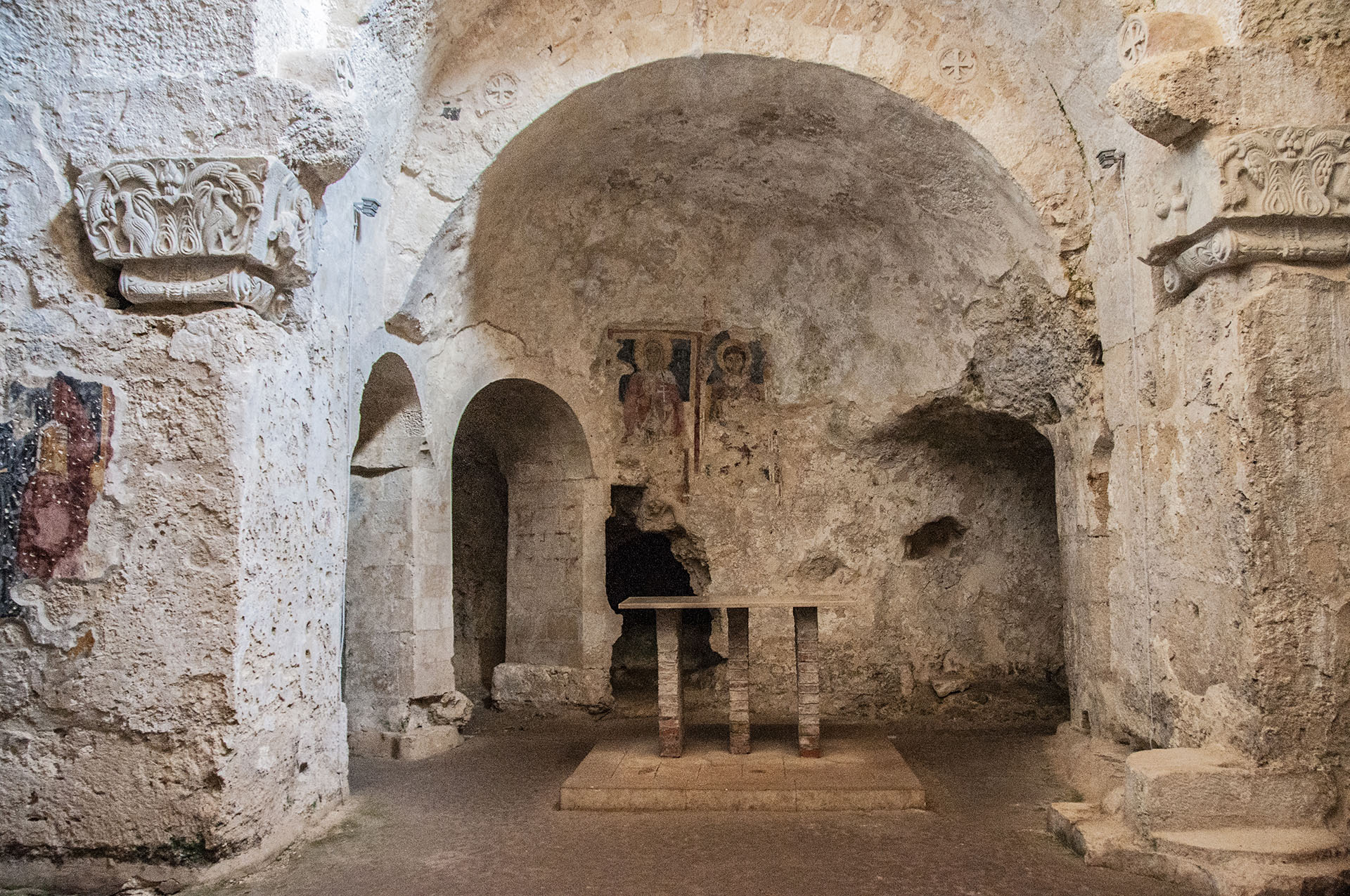 Between the central and southern apse there is a space that houses an arcosolium tomb, an arch-shaped burial structure surmounted by a niche and carved into the wall, with faint ornamental designs: it was the sarcophagus that held the remains of St. Marcian. Of the ancient archaeological findings, some apses and the remains of the opus sectile flooring are visible today.
In Norman times four
marble capitals
 were introduced at the corners of the nave, symbolising the Evangelists, and are set on stone pillars.
The rock face was also covered with and decorative motifs
frescoes
. Today the walls of the crypt have several layers of plaster where you can see the remnants of several superimposed paintings.