Mount Etna

Why is Etna one of the most studied volcanoes in the world?

Italy is one of the countries with the highest number of volcanoes in the world, and this is because of its complex geological history.
Starting from Tuscany, in different periods of activity a volcanic chain developed that ends with Vesuvius in the Italian peninsula and with the Aeolian Islands in the sea.
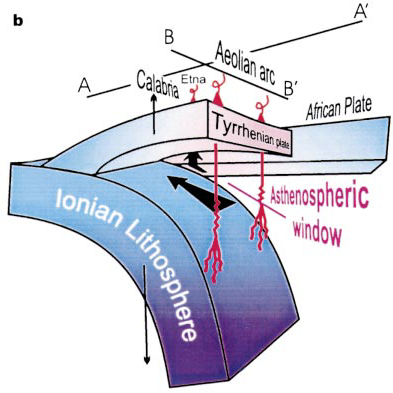
Etna is one of the most studied volcanoes in the world because of its position, which from a geological point of view is quite unusual. In fact, this volcano is isolated and not within an archipelago or chain of volcanoes. In addition, the magma of Etna is very similar to the magma emitted in a rather distant archipelago, in Hawaii.

The senses tell The summit craters

Torre del Filosofo: at the base of the summit craters (2950 metres)

Etna: a marvellous group of different types of flora

The 1669 eruption in Catania

Empedocles and his passion for Etna

Valle del Leone and the Elliptical

Humankind and the volcano: how should we behave? Volcanic risk

The different names of the “Muntagna”

An ever-evolving volcano

The continuous evolution of the Etna summit craters

Summit crater activity between 2011 and 2019

The senses tell Acireale

Lachea Island and the Aci Trezza Stacks

Why is Etna one of the most studied volcanoes in the world?

Val Calanna, the first step towards a single large volcanic structure

The “notches” of snow

The senses tell Valle del Leone

The earthquake that changed the geography of eastern Sicily in 1693

The senses tell Acicastello and Acitrezza

The 2001 eruption of Etna, when the Mountain seemed to be alive

The Jaci river

The Red Mountains and the destructive eruption of 1669

The Elliptical, the first great volcano of Etna

Malavoglia

The senses tell Torre del Filosofo

The first volcanic structures of Etna, between Aci Castello and Aci Trezza

Etna, a natural laboratory where experiments can be carried out

The Etna viewpoint

The eruption of 1928 that destroyed the town of Mascali

The Grand Tour in Sicily

The living mountain

Acireale and its “timpe”

The world’s first (almost successful) attempt to stop a lava flow: the eruption of 1991-93

The fault system of the “Timpe” of Acireale

The senses tell The Etna Viewpoint

The senses tell The Red Mountains

Acireale and reconstruction after the 1693 earthquake

The senses tell Val Calanna

A fauna yet to be discovered